

In the painting entitled ‘Quicksand’, (acrylic on panel, 40 x 30in, 2024) we are immediately confronted with the problem of where to begin reading. From habit we start in the top left and read down as if the landscape mimicked the written page. The symbol of a mustached gentleman smoking a pipe, the words ‘smoke shop’, but we know better, this must be a cannabis dispensary, there is certainly no market anymore for old fashioned smoking paraphernalia, especially next to a tattoo parlor. But given that the ‘Q’ in Liquor is missing and one of the signage rectangles is empty it becomes apparent this is a shopping center in a state of flux. Finally on the bottom right we finish our reading with the words ‘Hair Salon’, the textual part of our journey is over, and we can look at the other aspects of the painting. An enormous ancient fan palm that must sit on derelict land because it has never been pruned of its dead fronds, a lone streetlamp, a brownish polluted sky that could be dusk or dawn and finally a tiny city in the far distance just above the horizon line and the bottom of the painting itself, these elements emerge instantly using our habitual and varied experience of looking at pictures. The acts of deciphering the text and comprehending the image are separate and essentially use different parts of the brain. This painting is an exercise in survival training. Like a wild animal that must use all its facilities to assess danger (sight, smell hearing), humans rely solely on their brain agility and must use all the parts of cognizance to stay alive. After one millisecond I would choose not to frequent any of the establishments in this Mini-mall.
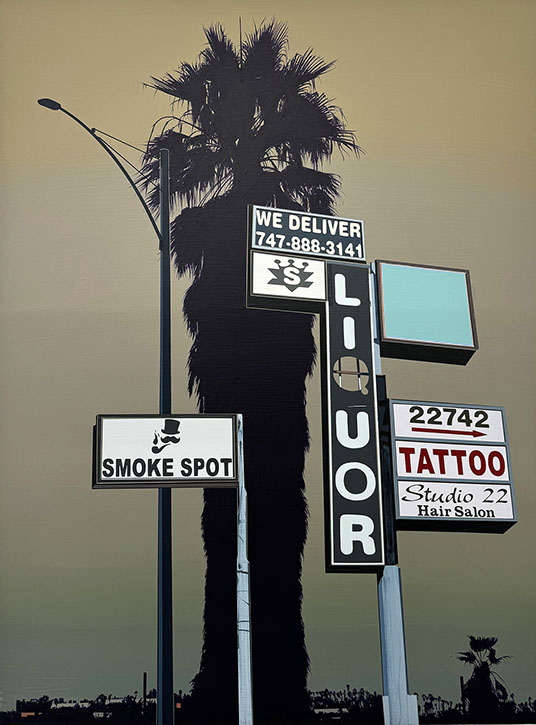
Quicksand, 40 x 30 in., acrylic on panel, 2024
The textual crust, or the text which inhabits every nook and cranny of the cityscape, is different from the city as text, which can be read or comprehended theoretically. A crust implies the thin hard outer layer of visual and material properties, and it always appears to us in specific forms and places. Linguist Rodrigue Landry and social psychologist Richard Bourhis took up this concept as a foundation for their semiotic theory of texts in urban spaces, which they called the ‘linguistic landscape’ (Landry Bourhis 1997). Linguistic landscapes are the sum of textual inscriptions present in an urban area, which span a variety of media and languages, therefore offering an insight into urban sociology, geography and culture. “The language of public road signs, advertising billboards, street names, place names, commercial shop signs, and public signs on government buildings combines to form the linguistic landscape of an urban agglomeration.” (Landry and Bourhis 1997: 25) In the ‘Mom and Pop Capitalism series the paintings depict the textual crust from below and within this agglomeration. Reading a city from below and within implies immersion within its unique patterns of semiotic communication, which form distinctive textual and visual environments and hold clues about urban politics and sociologies. Material surface interventions feed back into the larger cultural powers that characterize urban spaces and are also a reliable means of access to these powers.
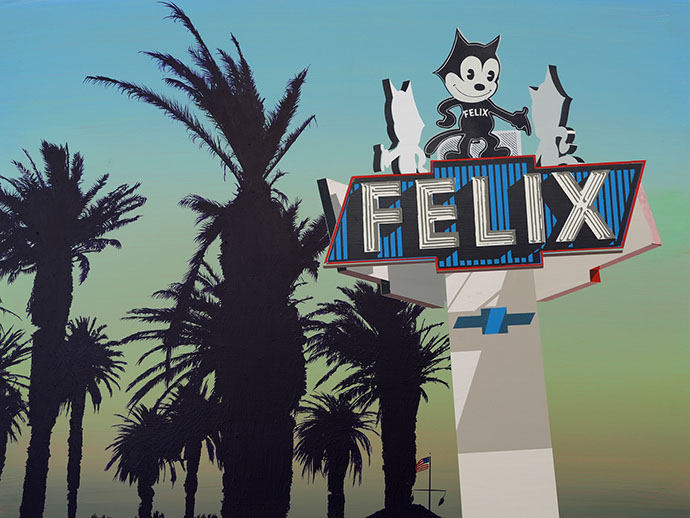
Felix, 30 x 40 in., acrylic on panel, 2024
In the painting entitled ‘Felix’, (acrylic on panel, 30 x 40in, 2024) there is only one word to interpret. The Latin word for "happy," "lucky," or "blessed “(but you must understand basic Latin), and implies in this circumstance a successful business transaction. Felix Chevrolet, Los Angeles' oldest automotive dealership, was founded in 1921 by Winslow B. Felix and gained fame for its iconic Felix the Cat mascot, a cross-marketing partnership with the cartoon character's creator, Pat Sullivan. Felix the Cat is an anthropomorphic young black cat with white eyes, a black body, and a giant grin, he is often considered one of the most recognized cartoon characters in history. Felix was the first fully realized recurring animal character in the history of American film animation. His famous pace—hands behind his back, head down, deep in thought—became a trademark that has been analyzed by critics around the world. Aldous Huxley wrote that the ‘Felix’ cartoons proved, especially the short cartoon entitled ‘Felix Dopes It Out’, 1924 (Felix tries to help an addicted suicidal man who is plagued with a red nose) that cinema can do a better job than literature in being socially responsible.
The painting’s use of one single word as the ‘textual crust’ of this painting refers directly to west coast conceptual artists such as Ed Ruscha, (Spam) and John Baldassari (Wrong). The word has such a depth of associations and references that it overshadows the other symbols in the picture, the cartoon cat, which is seen from three different angles, the ancient sickly palms, the blue Chevrolet insignia and the tiny American flag in the far distance. ‘Felix’ is ultimately and heroically a landscape painting and quite plausibly a realistic depiction of a unique place in the world. This is the contradiction. Guy Debord observed in his 1967 book ‘The Society of the Spectacle’ the downgrading of ‘having’ into merely ‘appearing’ within contemporary capitalist society. He argues that social relationships between people (including commercial ones) had unwittingly become mediated by text images. In this case the image of the word ‘Felix’ has replaced any human emotional response to social interaction including the idea of purchasing a new car. In the painting the word ‘Felix’ is carefully rendered as a neon sign, the letters constituted from bent glass tubes filled with gas. For Debord, ‘Spectacle’ was anything put up in lights and referred I think directly to a Las Vegas idea of showmanship, the thematization of text in words like ‘Sahara’, ‘Flamingo’ and ‘Mirage’. Debord defines spectacle as "capital accumulated to the point where it becomes image".
The signage in the Mom and Pop Capitalism series fundamentally act as Trojan horses, sneaking ideas (about, for example, all the ways that modernism and its leading practitioners have reached a dead end) into Painting. In the guise of mere empiricism: lists of services, day to day essentials, diagrams and measurements, the signage in these paintings invite themselves into the discourse of what is contemporary image making.
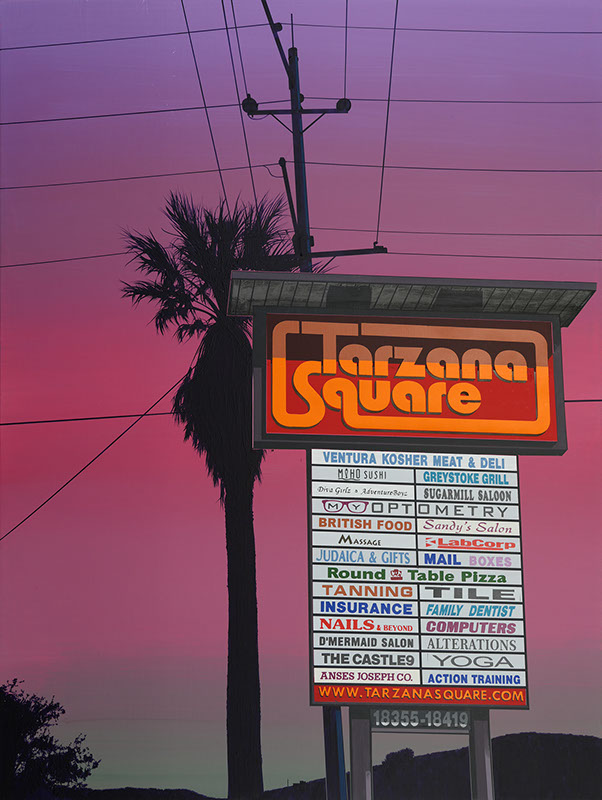
Karmacoma, 48 x 36 in., acrylic on panel, 2024
The painting entitled ‘Karmacoma’, (acrylic on panel, 48 x 36in, 2024) suggests a relationship to religious iconography. A central cruciform structure crowned with the words ‘Tarzana Square’ and covered in an elaborate list of services and patronage. A saint surrounded by his disciples. Flanked by an ancient palm tree and immersed in what feels like a desert sunset the painting aspires to the iconographic standard of the “flight into Egypt”, all that is missing is the donkey. The telephone pole half hidden and emerging from the top of the signage has the distinct quality of a crucifix. Almost every human desire is addressed in the enterprise menu which dominates the painting. Tarzana Square is garden of earthly delights in which every want is fulfilled by the plentitude of Mom and Pop entrepreneurialism.
Tarzana is a neighborhood within the greater expanse of the city of Los Angeles and more specifically the geographical area known as the San Fernando Valley. In February 1919 Edgar Rice Burroughs author of the popular ‘Tarzan’ novels and films, relocated to Los Angeles from Oak Park, Illinois. Burroughs purchased a large tract of land and established the Tarzana Ranch. Burroughs subdivided and sold the land to developers in the 1930’s and Tarzana was born, perhaps the first thematized real estate development in the US. In Burrough’s series of fictional novels (26 in all), "Tarzan" is the ape-name of John Clayton, Viscount Greystoke. After Tarzan’s parents die tragically on a trip to Africa, Tarzan is adopted by a tribe of giant apes known as the Mangani. Tarzan's jungle upbringing among the Mangani gives him abilities far beyond those of ordinary humans. This painting suggests a complete lack of distinction between fact and fiction, the desires of the consumer and the advertising strategies of the purveyors of services and goods have comingled into a type of mega-fantasy. Ironically ‘Action Training’ is offered as well as Tarzan inspired food at the ‘Greystoke Grill’ and ‘Tanning’. All necessary preconditions for a legitimate Lord of the Jungle.
In Anti-Oedipus: Capitalism and Schizophrenia, Gilles Deleuze and Felix Guattari describe the late phases of capitalism as "Radical Deterritorialization”. Deterritorialization describes the process where the very basis of one's identity is eroded, eventually becoming indistinguishable from a myth, a fantasy or a brand. Humans lose their individuality and become a set of consumer tendencies and purchase histories. In the mind’s eye it’s a cowboy or an astronaut or a British lord reared by apes who is taking a yoga class or getting a massage or having their hair styled. In a more traditional scenario, a family might pretend that they are the descendants of royalty, adding a ‘Von’ in front of their last names or tracing their ancestry back to some obscure aristocrat. After several generations this mythmaking becomes reality. Deleuze and Guattari propose that the process is now instantaneous. You are what you fantasize to be every time you consume, like a simultaneous cosplay event in which all factors involved in the exchange of commodities and services are implicated. The title of Rubsamen’s painting, ‘Karmacoma’, sums up the essence of Deleuze and Guattari’s thesis. Karma is an ancient Indian concept that refers to an action or deed, and its effect or consequences. Cause and effect, where actions (both physical and mental) lead to consequences, both in this life and potentially in future lives. A Coma is a prolonged state of deep unconsciousness where a person is unable to respond to stimuli, including pain, sound, or touch. A person in a coma is unaware of the world around them and is impossible to wake.
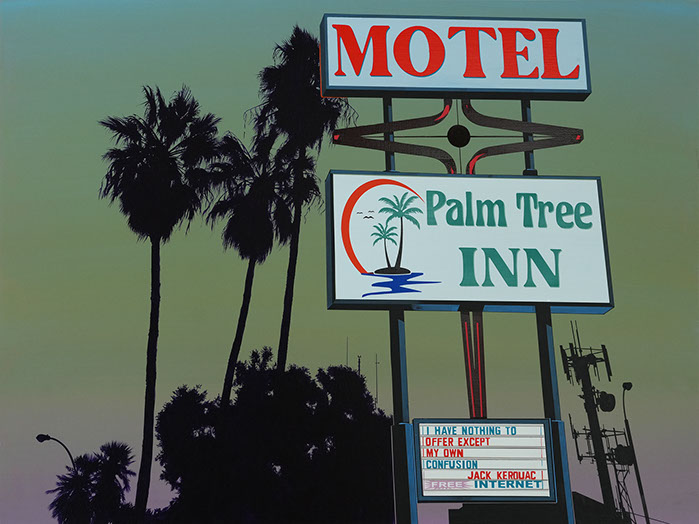
Low Weekly Rates, 36 x 48 in., acrylic on panel, 2024
The painting entitled ‘Low Weekly Rates’, (acrylic on panel, 36 x 48in, 2024) introduces at the bottom right of the painting a very different type of ‘Textual Crust’. It portrays a letterboard with a quote from the beat poet, jack Kerouac, “I Have Nothing to Offer Except My Own Confusion” A letterboard or reader-board also known as a marquee, is a customizable sign that employs individually movable letters. Letterboards are used by movie theaters to list their current shows, churches to display the times of the mass and businesses whose signs must be constantly changed to follow fluctuations of price and availability. The painting uses the letterboard motif to send a personal message to the viewer, one that circumvents and sidetracks the normal sequence of the viewing process. It is a direct plea to a different type of critical thinking, one that asks the viewer to ignore their initial conclusions and reconsider the motives of the Artist based on a personal confession. Confessions of sorts are rampant in the linguistic landscape. They include Graffiti like ‘I love you’, as well as warnings such as ‘keep out!’ or ‘Dogs may bite!’ and pleas to good behavior which act as confessions like ‘People are Sleeping!’ The painting speaks through Jack Kerouac’s confession and admits its doubts about choosing the subject matter, the colors and style. The painting confesses to itself that its motives completely mysterious. An awkward graphic of two palms serves to illustrate the name of a motel, ‘The Palm Tree Inn’, while ehind the 50’s era Motel signage there lurks a group of real palms painted as portraiture as they describe a type of botanic individuality that can only describe one specimen in one location in the world. The disparity between the commercial representation of nature as commodity and the organic individuality of real living creatures is at the heart of this pictorial confession about the role of the artist in contemporary society.
